Applying for a U.S. CPA as a Canadian CPA via the MRA
This is an update to Eric Fong's post on his experience getting his CPA(IL). Unfortunately Eric's post is about 5 years out of date (as of the writing of this post) so I've included some updates based on my experience. Unfortunately his guide is much prettier than mine as I do not have his developed aesthetic taste.
Background: I went to the University of Waterloo and completed the MAcc Program. I did not do the audit PEP equivalent, nor did I write the Audit role for the CFE. As a result, I have a post-merger CPA without a public accounting license (PAL). I also have approximately zero hours of audit experience.
The good news is that to be eligible for the Mutual Recognition Agreement (MRA), you do not need audit experience — you just need to pass the Post Designation Public Accounting (PDPA) module.
Costs
All costs in $CAD.
| Item | Cost |
|---|---|
| PDPA Program | $1,496.00 |
| Letter of Good Standing from CPAO | $28.25 |
| NASBA Eligibility Assessment | $351.87 |
| IQEX Exam | $921.65 |
| NINJA CPA Review (course) | $121.78 |
| NINJA CPA Review (supplement) | $94.17 |
| Illinois CPA Certification application | $490.31 |
| Total costs incurred to date | $3,504.03 |
Phase 1 — PDPA (April – December)
Since I didn't have an audit background, I had to sign up for the PDPA. It is run once a year, and you need to first request an eligibility assessment. Be careful about the dates as you may end up delayed a whole year. I submitted my eligibility assessment late, but lucky for me the kind folks at CPAO still permitted me to write the exam.
Exam covers a bunch of content, but the focus is audit and accounting. You also need breadth in tax. It is a mix of MC and cases.
Tax: I did all the practice questions in probably half a day without reading the content. Benefits of having worked in Tax for 7 years. I averaged a score of roughly 90%. Tip: If you're in tax, don't overthink it. Some of the content is technically wrong in edge scenarios, but generally correct. They don't test you for a depth requirement, just meet the basic knowledge requirement.
Audit and FR: Admittedly I was out of practice (in the case of audit I was never in practice) in these fields so I had to do some revisions. Overall there was no content I didn't know at all, just stuff that I had to refresh. I studied for roughly a month using the CPA provided materials. I did not spring for any external resources. My average on the practice cases was 60% in Audit, and 80% in FR. I eventually got them both up to high 80%.
Exam: I finished the MC in about an hour, and the remaining time I used for the case. Partway through writing the case I realized that the name of the game is competency, not to exceed competency. I realized I was putting too much time and effort into a technically correct discussion of consolidation practices, and very quickly running out of time for the audit questions.
I still passed through. Results came out in December. I had actually totally forgotten I had written the test until I got the exam results.
Phase 2 — NASBA Application (December – Jan, approximately 2 weeks)
This phase is administratively excessively burdensome and unclear as a lot of it is directed to Americans.
Go to dashboard.nasba.org and the CPA Portal to make a profile.
When you select a jurisdiction, do not select the state you intend to apply to. There is an option specifically for IQEX — Canada.
Application questions:
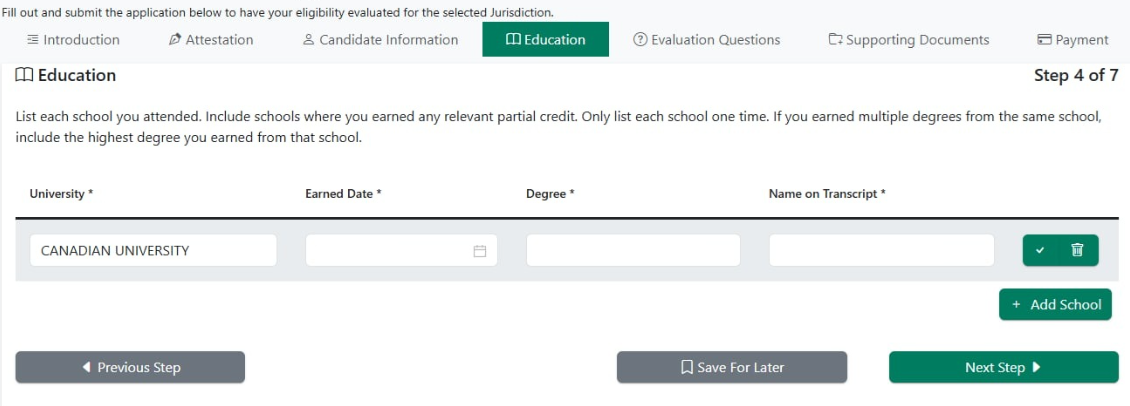
Education: If you're like me, your university will not be an option as you had your schooling outside of the U.S. There is an option for "Canadian University".
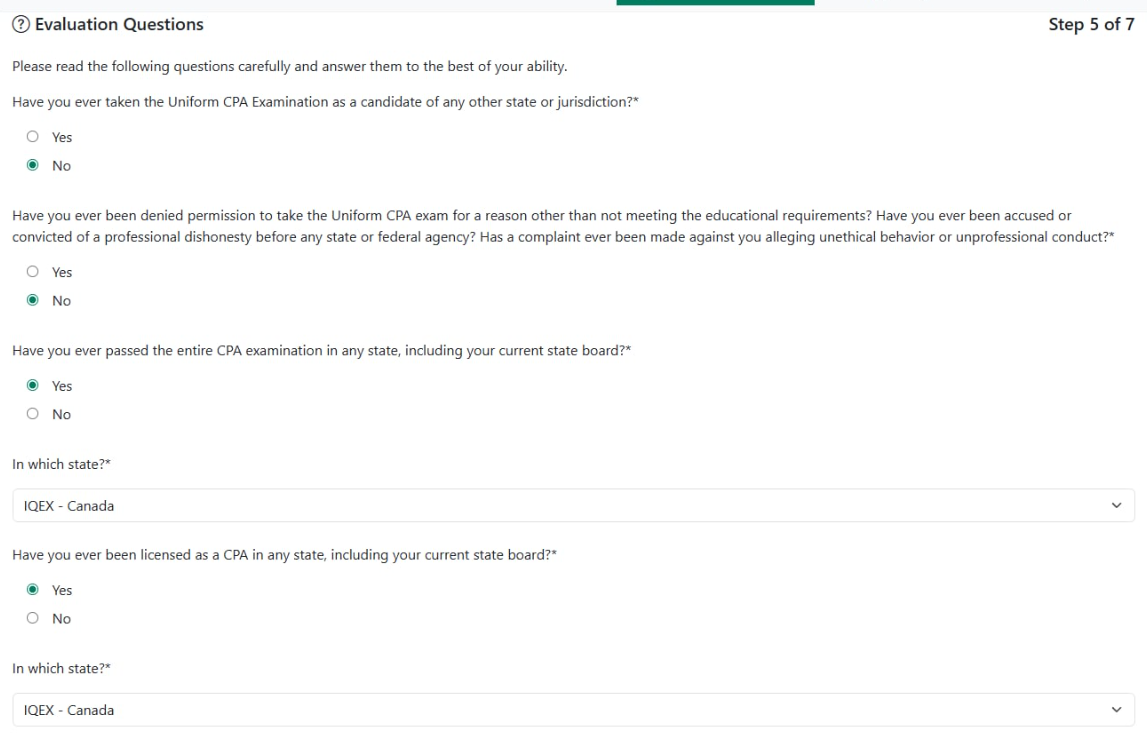
Evaluation Questions: I've never taken the Uniform CPA Examination, but there is a specific option to select IQEX — Canada when asked about your credentials. I believe this question is actually asking if you've taken the IQEX specifically.
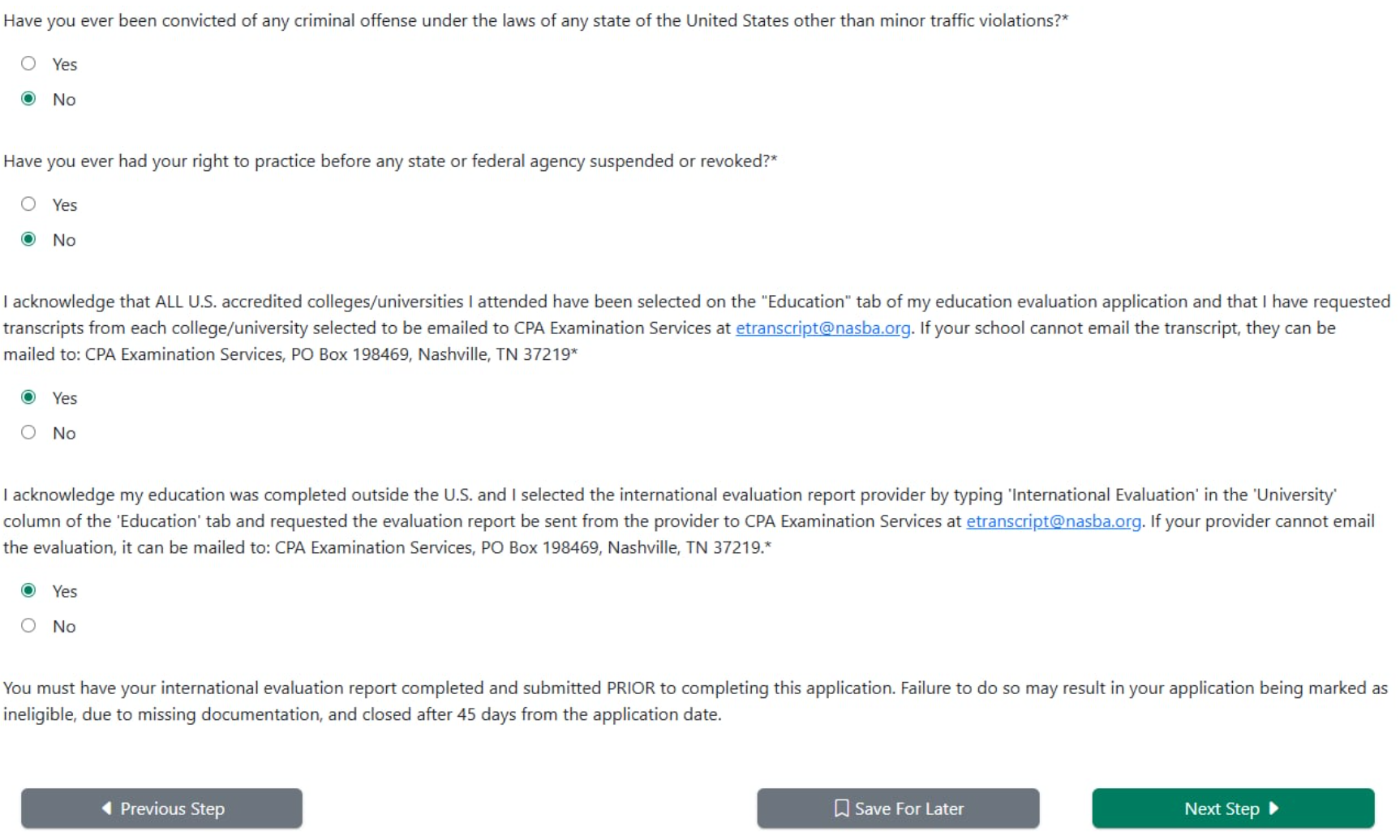
Evaluation (Continued): There's a section of the evaluation which asks you about transcripts. You do not need to submit transcripts if you're applying for the IQEX under the MRA, which I verified with a NASBA staff member. The system may prompt you for transcripts. What I did was when I submitted my Letter of Good Standing (LOGS, see more detail below), I called up NASBA and they were able to manually note that my transcript or equivalent was received.
Letter of Good Standing: The LOGS is essentially what will verify if you've met all the conditions under the MRA (which covers education requirements and practice/audit requirements). I applied for this through my CPAO Portal where it has a specific form requirement. Eric has a good guide on this:
"To obtain this on the CPA Ontario website, I went to the CPA Ontario Portal and clicked View All under Member Requests, went down to Letter of Good Standing (Customized) which led to the CPA Store.
At the CPA Store, I selected the Detailed Letter of Good Standing $25.00 and in the Purchase Comments, I added the following note:
'Would you please complete the Letter of Good Standing and forward directly to iqex@nasba.org and CC my email: ____________?
I also inserted a link of the NASBA form pre-filled with my info where indicated and signed with ink.'"
Note that since the divorce between CPAO and CPA Canada, there is now a specific CPAO form. After I submitted the request, CPAO followed up about 2 days later asking me to fill out their specific version (which said CPAO instead of CPA Canada).
Based on Eric's experience I had actually done the LOGS application first. The LOGS was sent to NASBA the same day I completed the application, and NASBA approved it roughly 5 days later.
Phase 3 — IQEX Exam (Summer 2026)
I got my study materials from NINJA CPA Review. I paid for one month of the full course then switched to one month of the MCQ supplement. I didn't have much formal education in U.S. tax, so I wanted a textbook I could refer back to.
In retrospect, the textbook wasn't that helpful — it's effectively a Word doc with some notes, typos, and page break issues included. If I did it again, I'd just buy the supplement for the MCQ test bank, and just ask a friend who has previously taken it for their notes for quick reference.
I paid for 2 months of access, but realistically almost all of the learning happened while grinding mock MCQs. To quote Catch Me If You Can: I studied for two weeks, and I passed.
Eric's post regarding the IQEX is now out of date. Although there are still 5 booklets, the IRC research question is no longer a thing, and the test is no longer adaptive — it does not get harder as you go.
Exam content: Compared to the Canadian CFE, the IQEX (essentially the REG section of the U.S. CPA exam) is significantly easier. It was about 70–80 MCQs plus roughly 8 fill-in-the-blank exercises. You get 4 hours — I finished in 1 hour 40 minutes, mostly because I took my time and worked through each question twice. That said, I came in with 7 years of tax experience and was already very comfortable with tax concepts generally. Realistically I think I spent about 50 hours studying for it: about 12 hours of cramming the day before the exam, and about 2 hour quick reviews in the evenings for the two weeks leading up to the exam (was slightly hard to stay focused when there was no challenge).
The hardest parts for me were (1) U.S. contract law, which I had zero prior exposure to, and (2) getting used to U.S. vocabulary and classifications — not because the concepts were hard, but because terms like "cost recovery" mean something different in Canadian tax, so I had to rewire some instinctive responses.
Exam admin: Fairly similar if you've ever done the LSAT or GMAT at Prometric. You go to the exam center, they do a security check, you sit down at a computer, and you do the exam. The writer next to me was stressed out and tried to debrief with me. He was writing the LSAT and couldn't understand why I was so relaxed.
The good thing about these exams being done through Prometric is that you get your results very quickly — about 2–3 weeks later. I passed with a score of 87.
Phase 4 — Applying to Illinois
I applied to Illinois - to my knowledge the only requirement was to pass the IQEX and have a year of work experience (which I met easily). I know of some folks who applied to Washington instead, as Washington recognizes the academic time spent in a PhD as work experience.
There's a two step process here, first you get the CPA certificate from the Illinois Board of Examiners (ILBOE), and then you apply for the license through the Illinois Department of Financial and Professional Regulation (IDFPR).
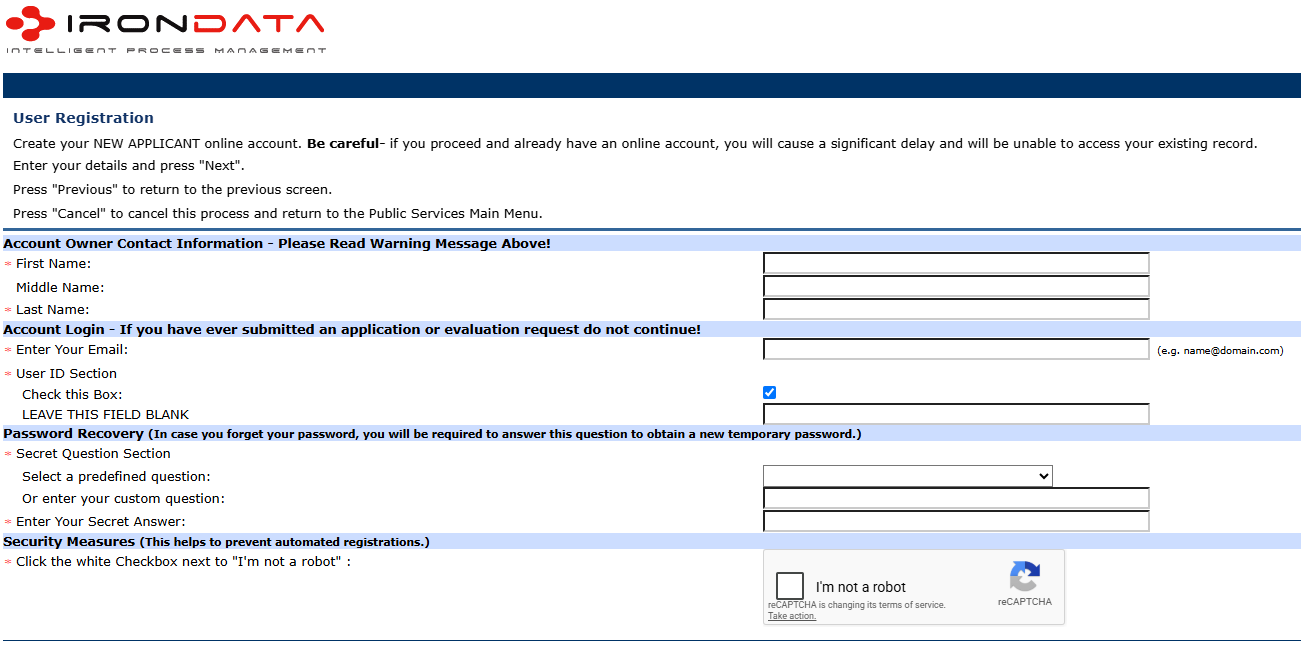
Illinois' system is fairly... archaic in design, but it gets the job done. I was amused there were reading comprehension questions (leave this field blank!)
Once registered, choose 7 - CPA Certification by International Qualification Examination (IQEX).
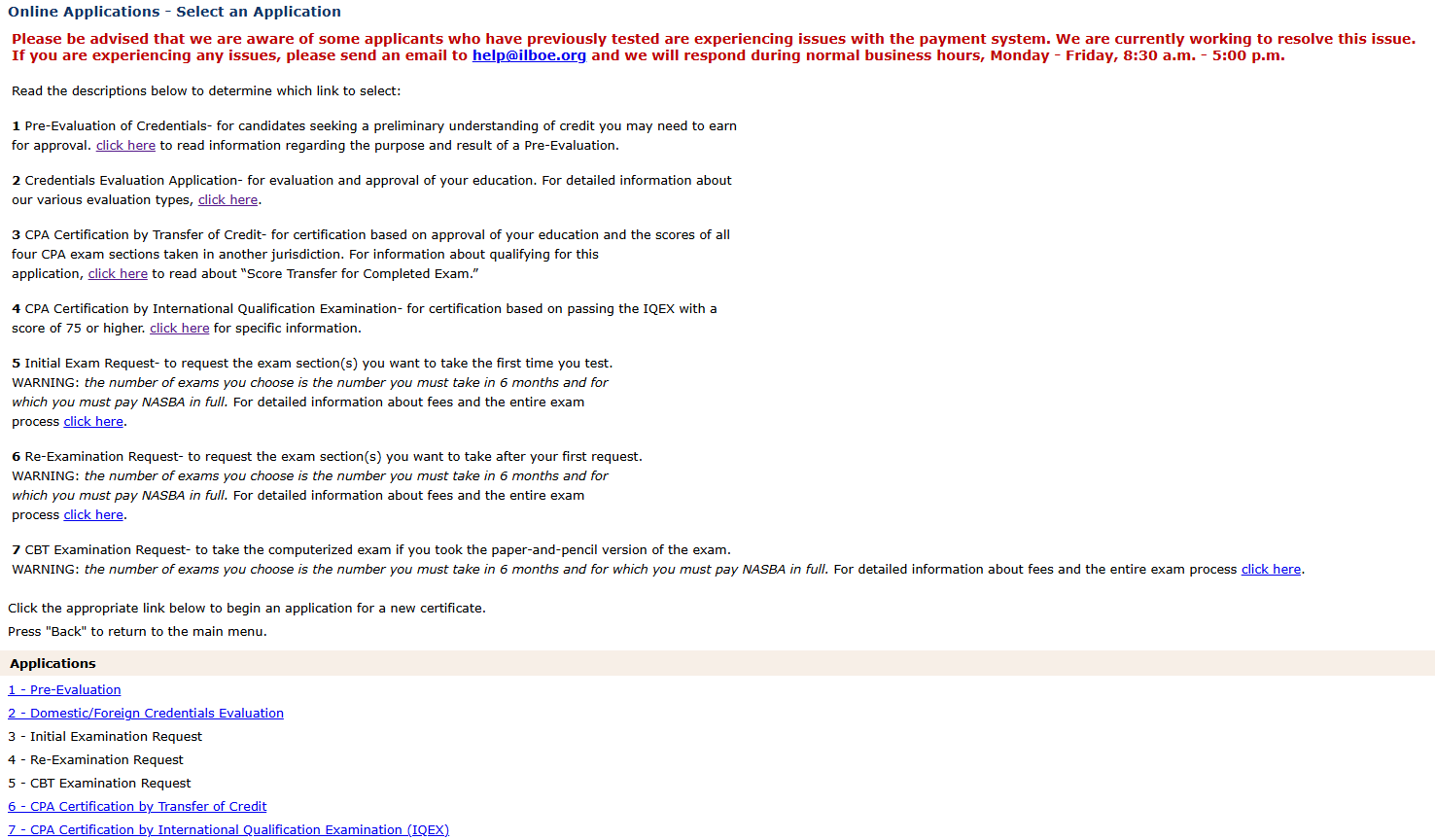
There's a US$345 fee for the IQEX application plus about a US$10 online processing fee (about $490 CAD). The IQEX Candidate Number was the National Candidate ID, which I found on my NTS.
You also need to ask NASBA (at nasbastore.org, different site) to send your official IQEX score report directly to the ILBOE. Go to the site and select NASBA Candidate Score Transfer. For the From Jurisdiction field, IQEX is an explicit option, and I chose Illinois as the To Jurisdiction. They say right in the instructions to use NASBA's shipping address to avoid pricey shipping costs. I wasn't actually charged anything for the score transfer itself.